What Is Recruitment Process Outsourcing (RPO)? A Complete 2026 Guide

What Is Recruitment Process Outsourcing (RPO)? A Complete 2026 Guide

Hiring has become one of the hardest operational challenges businesses face in 2026 — roles stay open longer, quality candidates are harder to reach, and the cost of getting it wrong keeps climbing. That’s exactly why more companies are turning to recruitment process outsourcing. But what is RPO, how does it actually work, and is it the right move for your business? This guide breaks it all down.

What is recruitment process outsourcing (RPO)?

Recruitment process outsourcing is a hiring model where you hand off part or all of your recruitment function to an external provider who works as an extension of your team. Instead of building a full in-house recruitment department or paying an agency a large fee for every single placement, you partner with an RPO provider who takes ownership of the process — sourcing, screening, interview coordination, and often onboarding support — while working under your employer brand.

The key difference from a traditional agency is integration. An RPO partner embeds inside your hiring process, follows your criteria, uses your applicant tracking system, and reports on the same metrics your internal team cares about. Over time it feels less like outsourcing and more like having a trained, ready-to-go hiring team on demand.

How does RPO work?

Most RPO engagements fall into one of three shapes, depending on how much support you need:

  • End-to-end RPO — the provider manages your entire recruitment function across all or most roles.
  • Project or on-demand RPO — support for a specific hiring surge, a new office launch, or a batch of hard-to-fill roles.
  • Selective / modular RPO — the provider owns one part of the process, such as sourcing or screening, while your team handles the rest.

A typical workflow looks like this: the provider learns your business and builds a clear talent brief, sources candidates through targeted strategies and professional networks, screens and evaluates for skills and culture fit, delivers a decision-ready shortlist, and supports interviews and offers through to onboarding. This is the same structured, six-step approach Aurrum uses across every search.

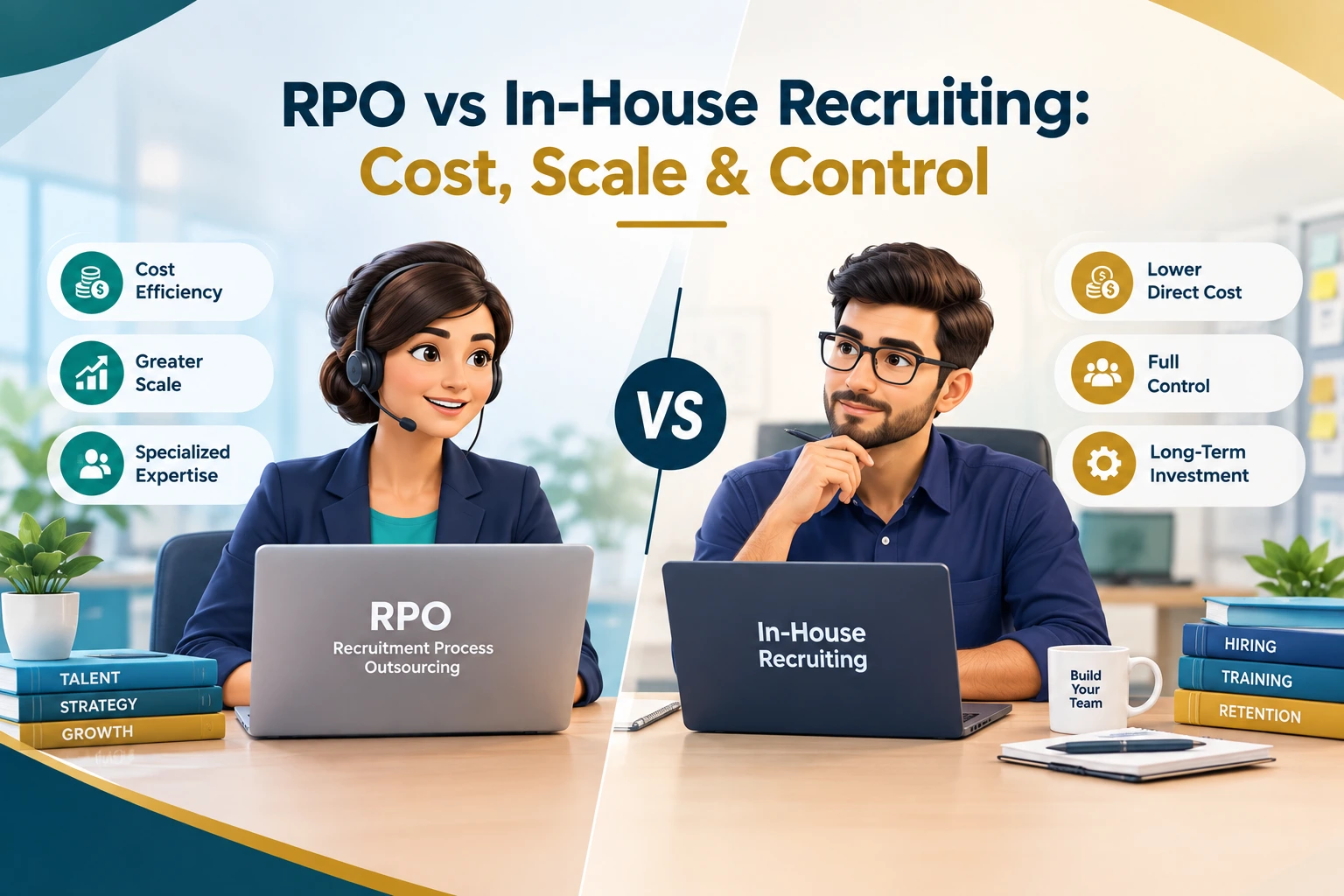
RPO vs. staffing agency vs. in-house hiring

These three models sound similar but their cost structures and incentives are very different:

  • Staffing agency — you pay a placement fee (often 15–25% of salary) per hire. Fast for one-off roles, but expensive and transactional at volume.
  • In-house recruiter — great cultural context and control, but a fixed salaried cost that’s hard to scale up or down with demand.
  • RPO — you pay for hours worked or an agreed scope rather than per placement, which converts a fixed cost into a flexible, variable one that scales with your hiring needs.

The benefits of recruitment process outsourcing

1. Lower cost per hire

Industry data consistently points to significant savings. Providers and analysts report that companies typically achieve 30–50% lower cost per hire with RPO compared with agencies or fully in-house teams, largely because you’re paying for results and capacity rather than repeated placement fees. With the average cost per hire in the US already sitting around $4,700 (SHRM), those savings add up quickly at volume.

2. Faster time-to-hire

RPO providers deploy dedicated sourcing teams and pre-built talent pipelines, which is why many organisations see time-to-fill drop by 30–40%. Every week a critical role sits empty carries a real cost in lost productivity and revenue — speed matters.

3. Better quality of hire

Because RPO teams screen thousands of candidates across many roles, they bring proven evaluation frameworks that improve match quality. Better matches mean stronger performance, smoother cultural fit, and lower turnover — the flip side of the real cost of a bad hire.

4. Scalability

Whether you need to fill five niche roles this quarter or fifty next quarter, RPO gives you elastic capacity without the overhead of hiring and training internal recruiters you may not need long-term.

When does RPO make sense (and when it doesn’t)?

RPO delivers the strongest ROI when you’re hiring at volume or scaling fast — typically around 15–25+ hires a year, unpredictable demand, or specialised roles your team can’t easily source. For steady, low-volume hiring of two to four roles a quarter, a single internal recruiter or project-based support may be the better fit. A good partner will tell you honestly which model suits your situation.

How to choose the right RPO partner

Look for a provider that: takes time to understand your business before sourcing; reports transparently on metrics like time-to-fill, cost, and quality; offers flexible models (end-to-end, project, or modular); and treats quality of hire — not just headcount — as the goal. Global reach is a bonus if you’re hiring across regions.

How Aurrum approaches RPO

At Aurrum, our Recruitment Process Outsourcing service lets companies outsource part or all of their recruitment to a committed, data-driven team that operates as an extension of your business. With 500+ placements, a 98% retention rate, and reach across six countries, we combine speed with a relevancy-first approach that keeps quality at the centre.

Thinking about outsourcing your hiring? Get a free quote and we’ll help you decide whether RPO is right for your business.

 

The Real Cost of a Bad Hire in 2026 (And How Data-Driven Recruitment Prevents It)

The Real Cost of a Bad Hire in 2026 (And How Data-Driven Recruitment Prevents It)

Every hiring manager has been there: a candidate looks perfect on paper, interviews well, and then within a few months, it’s clear the fit isn’t working. What often gets underestimated is just how expensive that mistake really is — not just in salary, but in lost time, disrupted teams, and missed opportunities. In 2026, with hiring budgets under more scrutiny than ever, understanding the true cost of a bad hire isn’t optional. It’s a business necessity.

What “Cost of a Bad Hire” Actually Includes

Most companies only calculate the obvious expense — salary and recruitment fees. The real cost runs much deeper:

  • Direct costs: salary, onboarding, training, and recruitment or agency fees already spent
  • Productivity loss: the gap between what the role needed and what the hire delivered, often for months before the issue is addressed
  • Team disruption: managers and colleagues spending time managing, correcting, or compensating for underperformance
  • Rehiring costs: starting the entire search, interview, and onboarding process over again
  • Opportunity cost: projects delayed, clients affected, or growth plans stalled while the role is effectively vacant in all but name

Industry estimates commonly place the cost of a bad hire at anywhere from 30% to over 200% of that employee’s first-year salary, depending on seniority and role complexity. For a mid-level hire earning $80,000, that can mean a real cost well over $100,000 once every factor is accounted for.

Why Bad Hires Happen More Often Than Companies Realize

Bad hires are rarely about a candidate being dishonest or unqualified. More often, the root cause is a mismatch that could have been caught earlier:

  1. Rushed hiring under pressure — filling a seat quickly instead of filling it right
  2. Over-reliance on interviews alone — without structured evaluation, interviews are highly susceptible to bias and surface-level impressions
  3. Weak candidate screening — resumes and references reviewed quickly instead of thoroughly
  4. Poor culture and role-fit assessment — technical skills matched, but working style or team fit ignored
  5. No data feedback loop — companies rarely track which hiring signals actually predicted long-term success, so the same mistakes repeat

How Data-Driven Recruitment Reduces Hiring Risk

This is exactly the gap data-driven recruitment is built to close. Instead of relying on gut feeling or a single strong interview, a data-driven approach brings structure and evidence into every stage of hiring:

  • Structured candidate scoring — evaluating candidates against consistent, role-specific criteria rather than subjective impressions
  • Predictive fit analysis — using historical hiring data and performance patterns to flag which candidate profiles are statistically more likely to succeed in a given role
  • Bias reduction — standardized evaluation frameworks reduce the influence of unconscious bias that can quietly derail otherwise good hiring decisions
  • Faster, more accurate shortlisting — filtering out weak-fit candidates earlier, so hiring managers spend interview time only on genuinely strong matches
  • Continuous feedback loops — tracking which hires perform well long-term and feeding those insights back into future sourcing and screening criteria

The goal isn’t to remove human judgment from hiring — it’s to give that judgment better information to work with.

The ROI of Getting Hiring Right the First Time

Companies that invest in stronger, data-backed hiring processes consistently see:

  • Lower turnover in the first 12–18 months, when bad hires are most likely to fail
  • Faster time-to-productivity, since better-matched hires ramp up quicker
  • Reduced hiring costs overall, even with a higher upfront investment in screening and evaluation
  • Stronger team morale, since existing employees spend less time compensating for underperforming colleagues

A slightly longer, more rigorous hiring process almost always costs less than the aftermath of a bad hire.

How to Start Reducing Bad-Hire Risk in Your Organization

  1. Audit your last 5–10 hiring decisions — look for patterns in roles that didn’t work out. Was it a skills gap, a culture mismatch, or a screening gap?
  2. Standardize your interview process — use consistent, structured questions and scoring criteria across all candidates for a given role
  3. Involve data earlier in the funnel, not just at the final decision stage
  4. Partner with recruiters who use evidence-based sourcing, rather than relying purely on resume volume

Reduce Hiring Risk With a Data-Driven Approach

Aurrum’s Data-Driven Recruitment service helps businesses hire with evidence, not guesswork — reducing turnover and improving long-term team fit. Get a Free Quote →

Aurrum Seat Sharing Model: Smarter Recruitment Process Outsourcing That Cuts NHS Costs

Aurrum Seat Sharing Model: Smarter Recruitment Process Outsourcing That Cuts NHS Costs

What is the Seat Sharing Recruitment Model?

The Seat Sharing Model is a smarter recruitment management way, especially for organizations such as the NHS, where demand is varied and constant. This model lets you flexibly share recruitment resources instead of paying for full-time dedicated recruiters that you may not always need, so you only pay for what you actually use.

And do you know the interesting part? Some studies have shown that approaches like Seat Sharing can lead to up to 31% faster hiring times while reducing agency and outsourcing costs. Imagine what those savings could mean to your company, filling critical roles more quickly, not just in budgets.

Supporting NHS Recruitment for Permanent & Temporary Roles

Our Seat Sharing Model is built to support the full spectrum of NHS hiring needs:

Permanent Positions

From frontline roles such as nurses, doctors, and allied health professionals to such critical back-office staff like administrators, we cover it all.

Temporary/Locum Roles

We help NHS trusts to fill all roles quickly without the need to pay inflated agency fees. These roles can include agency nurses, seasonal staff for covering demand, or urgent short-term placements.

The model ensures that NHS leaders can maintain continuity in permanent hiring with flexibility in temporary staffing, all while cutting unnecessary costs.

Aurrum RPO Revenue Models & Value Delivery

Every NHS trust has different needs, so we don’t believe in a one-size-fits-all approach. That’s why we provide various Recruitment Process Outsourcing revenue models to align recruitment with budgets and hiring targets:

Cost per Hire

Perfect for both permanent hires and urgent temporary roles. You only pay for the results, no hidden costs.

Management/Monthly Fee Best for continuous, high-volume hiring needs, where consistency and speed are important.

Management/Monthly Fee

Best for continuous, high-volume hiring needs, where consistency and speed are important.

Project-Based or Hybrid Models

Ideal for surge hiring cycles, seasonal demand, or special projects where flexibility is key.

Each of these models is tailored to maximize ROI for the NHS, reduce reliance on costly agencies, and bring transparency into recruitment.

Why Choose Aurrum RPO: Trust, Expertise, and Partnership

Working with Aurrum means more than outsourcing, it means building a partnership. We bring:

    · Proven healthcare expertise: Our recruiters have experience with NHS hiring requirements as well as compliance standards.

    · Scalability: Our Seat Sharing Model adjusts to your needs, whether you need one hire or hundreds.

    · Cost savings: NHS trusts save significantly on healthcare recruitment outsourcing by reducing expensive agency dependence.

    · True partnership: We act as part of your team, and align with your aims by guaranteeing each hire brings value.

With Aurrum, you don’t just get a vendor; you get a trusted partner because we are dedicated to solving an NHS challenge.

Conclusion

The NHS will continue to face workforce-related challenges, but rising recruitment costs don’t have to be one of them. Aurrum Seat Sharing Model provides you with a smarter, more cost-effective way to fill both permanent and temporary roles, while reducing your reliance on agencies.

Scaling Smart: Why Startups Choose Aurrum Talent Mapping Services?

Scaling Smart: Why Startups Choose Aurrum Talent Mapping Services?

A startup may look good for sometime, until you know the dark side of it. The probability of failing is high for startups. And to scale startups, the solution is not always funding or product. Most of the time, it is the people.

That’s why more and more growth-driven startups are turning to Talent Mapping Services to secure their future leaders and build strong teams from day one.

At Aurrum, we combine the sharp foresight of an Expert Recruitment Consultancy with Data-Driven Recruitment methods to help startups scale smart. But how exactly does this work—and why is it game-changing? Let’s break it down.

What Is Talent Mapping and Why Does It Matter for Startups?

Talent Mapping isn’t just about filling today’s vacancies. It’s about anticipating future needs and building a pipeline of candidates who can grow with your business.

Think of it as the “Google Maps for recruitment”—instead of wandering blindly in the talent market, startups know exactly where to look, who to target, and how to secure the right people before competitors do.

To optimize your adult learning, try these five tips that many of my clients and I have adopted:


Why it matters:

  • Many startups fail due to lack of the right team.
  • Hiring mistakes cost companies more than they think 
  • Startups with strong early hires have high possibility to scale successfully.

👉 Question to you: If you could predict and secure the talent you’ll need 12 months from now, how much smoother would scaling be?

The Unique Startup Challenge: Moving Fast Without Breaking Teams

Startups move fast—sometimes too fast. When you’re growing, every new hire shapes culture, impacts productivity, and sets the tone for the future.

Here’s where most startups struggle:

     · Reactive hiring: Waiting until the role is urgent before searching.

     · Time crunch: Startup founders often spend 40% of their working hours (Harvard Business Review) on hiring.

     · High attrition: Without the right cultural fit, early hires leave within a year.

    That’s why Aurrum Talent Mapping Services are designed specifically for startups. We don’t just find talent—we find the right talent, aligned to your growth vision.

How Aurrum Talent Mapping Services Work

At the core, we combine human expertise with AI-powered insights. Here’s the breakdown:

1. Deep-Dive Discovery

     o We study your business model, market positioning, and growth roadmap.

     o Identify roles you’ll need now, and 6–12 months down the line.

2. Market Intelligence

     o Use Data-Driven Recruitment tools to map where top candidates are located.

     o Understand salary benchmarks, skill availability, and competitor hiring trends.

3. Talent Segmentation

     o Shortlist active and passive candidates in your industry.

     o Build customized “talent pools” for different functions.

4. Strategic Candidate Engagement

     o Our recruiters don’t just reach out—they build relationships early.

     o By the time you’re ready to hire, candidates are already warmed up.

💡 Think of it as a “future-proof hiring funnel”—always ready when you are.

Why Startups Prefer Aurrum

So, why do startups specifically choose Aurrum Talent Mapping Services over traditional hiring?

1. Faster Hiring Cycles

Recruitment delays can cost startups valuable time. With pre-identified pipelines, time-to-hire reduces by up to 50%.

2. Access to Passive Talent
According to LinkedIn, 70% of the workforce is passive talent—not actively applying but open to opportunities. Aurrum helps startups tap into this hidden pool.

3. Cost Efficiency

Reactive hiring often leads to rushed decisions and higher costs. With talent mapping, you avoid expensive mis-hires and reduce overall recruitment spend.

4. Cultural Fit from Day One

Aurrum consultants blend human insight with data, ensuring every candidate aligns not just with skills but with your startup DNA.

5. Scalable Growth Support

As your startup grows, your hiring needs evolve. With continuous talent intelligence, you’re never caught off guard.

Real Impact: Numbers Don’t Lie

When startups embrace Talent Mapping Services, the difference is measurable:

     · 40% reduction in time-to-fill roles (LinkedIn Talent Trends).

     · 50% lower attrition in mapped hires compared to reactive hires.

     · 3x stronger leadership pipelines built within the first 2 years.

👉 Imagine saving months of lost productivity simply because you planned your hiring right.

The Human + Data Edge

While Data-Driven Recruitment provides insights, it’s the human touch that makes Aurrum different.

     · Our recruiters know how to read between the lines of a resume.

     · Our consultants understand founder psychology and startup dynamics.

     · Our AI tools give us speed, accuracy, and predictive power.

It’s the synergy of human expertise + AI precision that creates unbeatable hiring outcomes.

Scaling Smart with Aurrum

For startups, the question isn’t if they should invest in talent mapping—it’s when. The earlier you start, the stronger your foundation for growth.

At Aurrum, we’ve helped early-stage startups secure CTOs, product leaders, marketing heads, and engineering talent—often before they even posted a job ad.

Because scaling smart isn’t about chasing talent last minute. It’s about having the right people lined up before you even need them.

Final Takeaway

Scaling a startup is a roller coaster ride. It is never the same, sometimes you go to the peak and sometimes to the down. But the people you choose will make it enjoyable or risky.

That’s why startups choose Aurrum Talent Mapping Services. Backed by our Expert Recruitment Consultancy and Data-Driven Recruitment approach, we help you:

     · Predict talent needs before they arise

     · Build stronger, future-ready pipelines

     · Save time, costs, and reduce hiring stress

     · Secure leaders who will shape your growth journey

Ready to scale smart? Partner with Aurrum today and let’s map the talent that will power your tomorrow.